
Why Your Business Needs to Show Up in AI Search — Not Just Google
SGE, AIO, GEO, AEO — What They Mean, Why They Matter, and How Pune Businesses Can Win
There’s a quiet shift happening in how people find businesses online. And most business owners in Pune haven’t noticed it yet — which means the ones who do are about to have a serious advantage.
A few years ago, ranking on Google meant showing up in the ten blue links. You optimised your website, published some content, built a few backlinks, and if you did it right, you appeared on page one. Simple enough model.
That model is changing. Fast.
Today, when someone searches “best dermatologist in Pune” or “how to get more leads for my business without ads,” they don’t always scroll through ten websites anymore. Google’s AI Overview answers them directly at the top of the page. ChatGPT gives them a recommendation. Gemini summarises the options. Perplexity cites a few trusted sources.
The question is no longer just are you ranking on Google?
The question is: is AI recommending you?

What Just Changed — And Why It Matters Right Now
Google’s Search Generative Experience (SGE), now more commonly seen as AI Overviews, has fundamentally changed what “being visible online” means. Instead of showing a list of links, Google now generates a direct answer — pulling information from websites it considers authoritative, relevant, and well-structured.
If your website is one of those sources, you get cited. You get traffic. You get trust.
If it isn’t — even if you’re ranking on page one — you may still be invisible to a large and growing segment of searchers who never scroll past the AI-generated answer.
This isn’t something that’s coming. It’s already here. And for a small business owner in Pune, a startup founder, or a clinic trying to build consistent organic traffic — understanding this shift is the difference between growing online and slowly becoming irrelevant.
Three Terms You Need to Know (Explained Without the Jargon)
You’ll start hearing these more and more. Here’s what they actually mean for your business.
AEO — Answer Engine Optimisation
This is about structuring your content so that AI tools and search engines can pull direct answers from it. When someone asks ChatGPT “which digital marketing agency in Pune is good for small businesses” — AEO is what helps your business get mentioned. It means writing content that directly answers specific questions your customers are asking, in a clear and structured way. Think FAQs, concise explanations, and content that gets to the point.
A physiotherapist in Kalyani Nagar who writes a clear, well-structured article on “what to do in the first 48 hours after a knee injury” isn’t just being helpful — they’re giving AI models exactly the kind of citable, trustworthy content they look for.
GEO — Generative Engine Optimisation
GEO is the practice of making your content attractive to AI-generated search results — so that when Gemini, ChatGPT, or Google’s AI Overview generates a response, your business is one of the sources it draws from. It goes beyond keywords. It’s about topical authority, content depth, credibility signals, and being genuinely useful across a broad range of related questions in your field.
A startup founder in Hinjewadi who publishes consistent, honest, well-researched content about “funding options for early-stage startups in India” isn’t just blogging — they’re building the kind of topical authority that AI engines recognise and cite.
SGE / AI Overviews
This is Google’s own AI-generated summary that appears above traditional search results. It’s the most visible change most people have noticed. Getting featured here isn’t about tricks — it’s about having content that is clear, credible, specific, and genuinely answers what the searcher needs. It favours websites that have invested in real SEO, real content, and real expertise.
Why Traditional SEO Alone Is No Longer Enough
This isn’t an argument against SEO. Quite the opposite. Strong foundational SEO — a fast, well-structured website, quality content, local optimisation — is still the base of everything. Without it, none of the newer AI-focused strategies work.
But SEO alone, focused only on keyword rankings, is incomplete now.
Here’s a simple way to think about it. Imagine two dental clinics in Pune, both ranking on page one for “dental clinic in Pune.”
Clinic A has a well-optimised website with a few service pages and some basic content. It ranks. It gets clicks.
Clinic B has everything Clinic A has — plus a resource section where they’ve answered 40 common patient questions. “Is teeth whitening safe?” “What’s the difference between a crown and a veneer?” “How do I know if I need a root canal?” Each answer is clear, structured, and genuinely helpful.
When a patient asks ChatGPT or Google’s AI “is teeth whitening safe in Pune?” — which clinic do you think gets cited?
Clinic B isn’t just ranking. It’s being recommended. That’s the shift.
Organic Traffic in the Age of AI: What Actually Works
The businesses winning organic traffic right now — without depending entirely on paid ads — are doing a few things consistently.
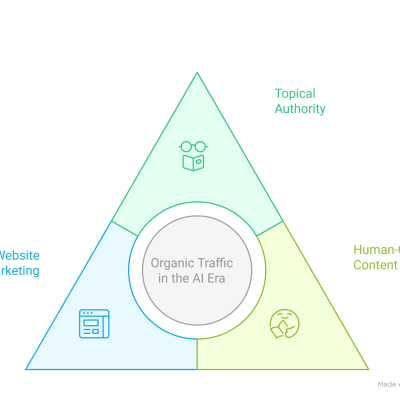
They’re building topical authority, not just chasing keywords. Instead of writing one blog post about “SEO tips,” they’re covering the entire subject area — what is SEO, how does it work for small businesses, what’s the difference between on-page and off-page, how does local SEO work in Pune, how long does it take. When you own a topic comprehensively, AI models treat you as a subject matter expert and pull from your content regularly.
An interior design firm in Pune that has answered every possible question a homeowner might have — from “how much does a 2BHK interior cost in Pune” to “how to choose between modular and carpenter-made furniture” — doesn’t just rank for a few keywords. It becomes the reference point for an entire category.
They’re writing for humans first, AI second. There’s a temptation to over-engineer content for AI systems. But the most effective strategy is simpler: write genuinely useful content that answers real questions clearly. AI models are trained on human behaviour — they recognise what people find helpful, what they trust, and what they return to. Content written to manipulate an algorithm feels hollow. Content written to genuinely help a reader earns citations.
They’re investing in website marketing, not just website presence. There’s a big difference between having a website and actively marketing through your website. A website that gets updated regularly, loads quickly, is structured clearly, and contains content that answers current questions — that website generates organic traffic. A static brochure site from 2019 does not, regardless of how beautiful it looks.
A small business owner in Pune who treats their website as a living, working asset — rather than a one-time project — will consistently outperform competitors who see it as a fixed expense.
A doctor can spend ₹50,000 a month on Google Ads for “orthopaedic specialist in Pune.” Or they can invest in building a resource hub on their website — answering questions about knee pain, sports injuries, post-surgery recovery — and rank organically for those searches for years. The second option builds trust. The first one buys attention.
Both have a role. But only one builds an asset.
What This Means for Businesses in Pune Specifically
Pune is one of the fastest-growing cities in India for IT, healthcare, education, and service businesses. The number of people searching online for local services — whether it’s a CA in Kothrud, a digital marketing agency in Koregaon Park, a clinic in Baner, or a SaaS startup looking for B2B leads — is growing every month.
At the same time, most local businesses are still playing a 2020 game in a 2026 search environment. Their websites haven’t been updated in years. Their content strategy, if they have one, is a few social media posts. They have no structured answers to the questions their customers are actually asking.
That’s not a criticism — it’s an opportunity.
Because the business that starts now — building real content, structuring it for AI and answer engines, investing in genuine SEO and website marketing — isn’t competing with the entire internet. It’s competing with the five or ten similar businesses in Pune that haven’t woken up to this shift yet.
That race is very winnable.
The Full Picture: SEO + AEO + GEO Working Together
None of these strategies exist in isolation. Think of them as layers that build on each other.
Strong SEO gives you the foundation — a website Google trusts, content it can index, a local presence it can verify. Without this layer, nothing above it works.
AEO builds your question-and-answer credibility — making you the source that gets cited when someone asks a direct question in any search environment, whether it’s Google, ChatGPT, or voice search.
GEO extends your authority across AI-generated results — ensuring that when generative engines summarise answers in your industry, your content and your business is part of that conversation.
Together, they create the kind of organic traffic that doesn’t evaporate when you pause an ad. Traffic that grows with time. Traffic that brings genuinely interested, high-quality leads — not casual browsers.
A startup founder who gets recommended by ChatGPT when a potential investor searches “reliable SaaS companies in Pune.” A clinic that appears in Google’s AI Overview when a patient searches for their specific symptom. A consultancy that gets cited by Perplexity when a business owner asks about their service area.
That’s not luck. That’s what happens when you build the right kind of digital presence — consistently, patiently, and with genuine intent.
The Window Is Open. But Not Forever.
Here’s the honest truth about where we are right now: early movers in AEO and GEO have a significant advantage, because most of their local competitors haven’t started yet. The businesses that build topical authority, structure their content for AI, and invest in proper website marketing over the next 12 months will be very difficult to displace later.
The window is open. But just like early SEO, it won’t stay this accessible forever.
The question isn’t whether AI search is changing how customers find businesses. It already has.
The question is whether your business will be the one they find — or the one they never knew existed.
At Prospera Digital, we help businesses in Pune build search strategies that go beyond traditional rankings — covering SEO, AEO, GEO, and website marketing built for how people actually search today. If you want to show up where your customers are looking, let’s have a real conversation.
Frequently Asked Questions
The best digital marketing in 2026 will be intent-driven and system-based. Businesses will need integrated strategies that combine AI-supported insights, multi-platform search visibility, structured content, and data-led advertising rather than relying on isolated tactics or short-term trends
Businesses should focus on building strong digital foundations, including a well-optimized website, clear messaging, reliable data tracking, and consistent content. Preparing early for AI-driven search and platform-centric user journeys is essential for sustainable growth.
No. AI enhances execution, but strategic planning and decision-making remain human-led. The best digital marketing in 2026 will involve agencies using AI as a support tool while maintaining oversight, creativity, and business alignment.
User behavior has shifted toward social platforms, voice assistants, marketplaces, and AI tools. Modern SEO focuses on visibility across all discovery platforms, allowing businesses to reach customers wherever they search.
If your strategy prioritizes intent, structured content, measurable outcomes, and adaptability across platforms, it is future-ready. Strategies built solely on automation or outdated SEO practices may require immediate refinement.